 My Employee is Leaving
Read the story
A short series about what actually left when one person did.

An SRE is overwhelmed by an incident, highlighting the risks of unshared knowledge.

Without the SRE, the team grapples with ambiguous instructions and unclear incident response plans.

Critical feedback from the SRE’s prior experience is lost, resulting in a poorly outlined incident response.

The runbooks’ reasoning and the incident history, in the Knowledge Transfer Report — open risks named.
In brief: what happens when a Site Reliability Engineer leaves?
Direct consequence includes an increase in system downtimes and difficulty in executing incident response plans.
What reliability knowledge should be recorded first?
Documentation should prioritize incident response protocols and capacity planning thresholds.
Which on-call context is usually left undocumented?
Commonly overlooked are undocumented workarounds and shadow systems that the SRE managed.
What should the first two weeks after an SRE resigns cover?
The manager should conduct a structured knowledge transfer interview with the departing SRE.
When a Site Reliability Engineer departs, various operational systems and protocols are at risk. Here are key breakdown areas:
Teams often face higher downtime risks due to:
Unmonitored Services: Loss of real-time insights could lead to outages unnoticed until it’s too late.
Misconfigurations: Previous knowledge of unique cloud resource configurations might be lost, increasing outage probabilities.
Slow Incident Responses: Without documented escalation paths and alert systems and on-call rotas, response times may lag.
The potential impacts include:
Confusion in Troubleshooting Teams: Teams may find themselves misaligned without the SRE’s historical context on incidents.
Ineffective Post-Mortems: Critical self-reflection exercises may miss necessary feedback loops without the SRE’s voice in the room.
Fragmented Documentation: Aspects of system performance and reliability might remain undocumented, creating knowledge gaps.
When demand surges, operational gaps may show:
Capacity Planning Challenges: Without established thresholds, scaling decisions may become delayed or erroneous.
Performance Issues: Compromised application performance effects and user experience could go unnoticed.
The Knowledge Transfer Report records the incident history, the reasoning behind the runbooks and the open risks.

A Site Reliability Engineer possesses deep and nuanced understanding across several knowledge domains critical for maintaining reliable systems.
Collaboration from development teams, product managers, and operations teams rely heavily on these knowledge domains to maintain smooth operations, demonstrating their critical importance.

To extract essential knowledge for Site Reliability Engineer, an AI interview tailored for Site Reliability Engineers focuses on specific points where undocumented processes often align.
This structured approach aims to capture not only the critical knowledge but also the underlying rationale behind key operational decisions.

A comprehensive knowledge transfer report equips managers with actionable insights to mitigate risk post-departure from an SRE.
Operational Playbooks: Documented emergency procedures for incidents ensuring quick recovery.
Decision Rationale Documentation: Insight into the thinking that guided the architectural and operational decisions.
Thorough System Documentation: Complete records of system dependencies, monitored metrics and any complex configurations established.
Risk Assessments: Detailed evaluations of potential fallbacks linked to the departure.
Handover Checklists: Lists tailored to ensure all critical areas of knowledge have been addressed before the engineer leaves.
Utilizing these deliverables, teams can orient themselves during transitions, maintaining operational clarity.

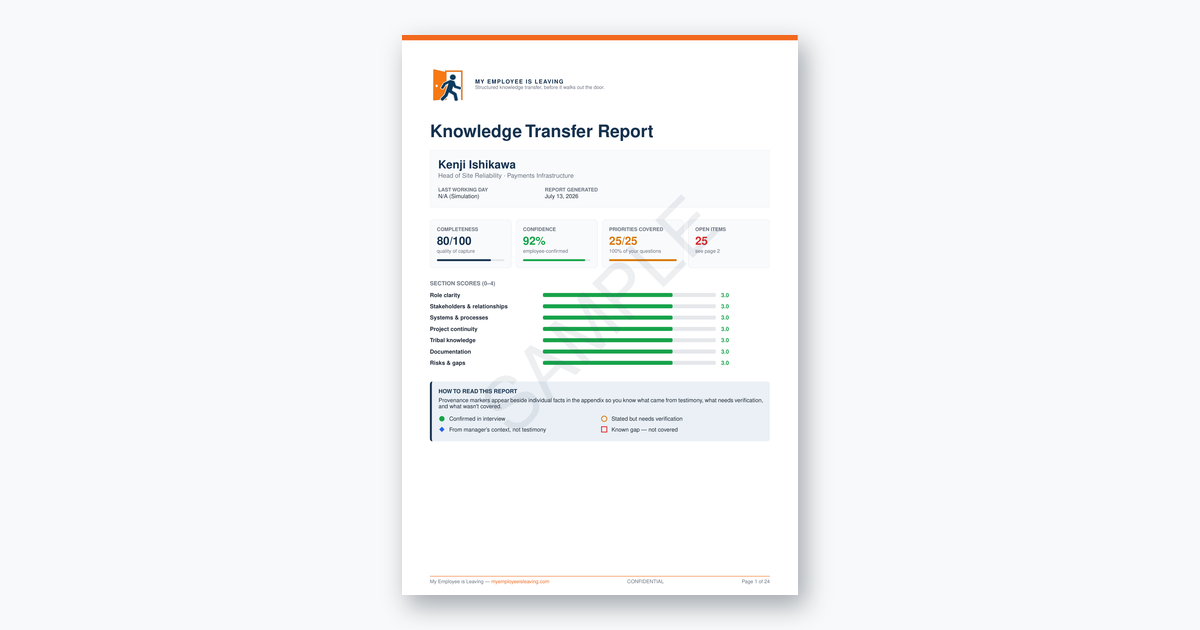
We generated a full Knowledge Transfer Report for a fictional Head of Site Reliability — the single point of failure on a payments cluster, mid-migration, with an audit deadline and a vendor renewal in flight. All 25 manager priorities addressed; every system only he understood, mapped.
A concise checklist to guide the knowledge transfer process, ensuring critical insights aren’t lost.
Outline all processes utilized during outages, referencing your on-call tooling for escalations.
Detail the historical metrics and planning strategies that influenced resource allocation decisions.
Identify custom scripts and undocumented tools used for monitoring and service health checks.
List important vendors alongside their contact information, including what tools they are responsible for.
Review and confirm captured information with the departing SRE to uncover any gaps.
Ensure any necessary adjustments to monitoring settings are communicated and documented.
A short series about what actually left when one person did.
A real Knowledge Transfer Report, start to finish.
One $1,000 credit per offboarding. No subscription. Your first offboarding runs free for 7 days — you buy the credit when you unlock its Knowledge Transfer Report.
Where reliability work actually lives.
The manager learns the Site Reliability Engineer is leaving and initiates the knowledge transfer process.
An AI-guided interview session is scheduled with the departing Site Reliability Engineer to systematically capture institutional knowledge.
The AI interview extracts undocumented workflows, vendor relationships, decision rationale, and operational edge cases.
A structured knowledge transfer report is produced, covering all critical domains, handover checklists, and risk areas.
The team reviews the report, identifies remaining gaps, and completes the handover before the departure date.
When an SRE departs, teams often face increased downtime and a struggle to maintain incident response efficiency due to lost insights.
Fit comes from the role’s operational knowledge, not its access level. It’s designed for operational knowledge — which alerts matter, escalation order, and capacity reasoning; passwords, credentials, and secrets stay out of scope.
Capturing knowledge involves structured interviews that focus on incident patterns, monitoring data, and undocumented practices from the SRE.
It’s multi-session by design, not a single sitting. An offboarding can cover up to ten structured topics with a total interview budget of around 300 minutes — in voice or text, paused and resumed around the person’s actual work. Time is budgeted, not promised: if topics don’t complete, the report says so rather than filling the gap.
Ensure a successful knowledge handover when your construction lead leaves. Capture insights and prevent operational hiccups with our checklist
When experienced energy staff leave, the operational know-how goes with them. A guided interview captures it while they can still confirm it.
Learn how to safeguard critical operational knowledge during employee transitions in industrial services with comprehensive knowledge transfer guide.