 My Employee is Leaving
A manager’s story about the knowledge that disappeared before the damage showed up
The Number We Couldn’t Unsee
Part 5 — The Number We Couldn’t Unsee
A fictionalized manager story by My Employee is Leaving
We had not built a resilient procurement system. We had merely borrowed her resilience.
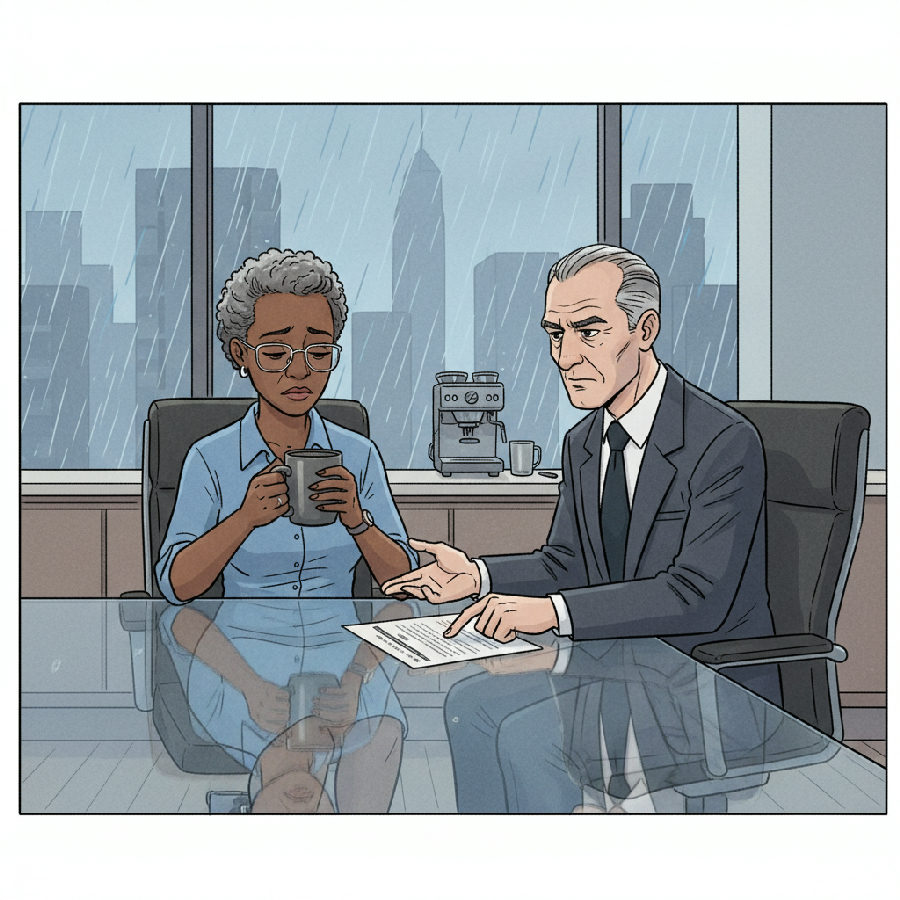
By quarter end, Finance and I sat in the conference room after dark with the numbers lit up between us. Outside the wind howled and the rain fell like sheets against the windows, rattling our insides. The office had emptied. Chairs pushed in, screens asleep; the whole place felt like the shell of a thing that it had been pretending to be all day.
The immediate damage, counted conservatively, was over $12,000. That was if you only wanted the clean part of the story. If you counted the lost account value, the consultant, the leakage, the drag, the attention, the quarter carried a scar of more than $40,000.
What’s worse is that the service we had declined because ‘knowledge transfer’ seemed manageable enough to do ourselves would have cost us just $1,000.
I said the number aloud. “One thousand dollars.”
Ten times the service cost would have been $10,000 and we passed that threshold without blinking and kept walking.
I drove home that night in complete silence, with no radio, no audiobook. Just the small sounds of the car’s tires against the asphalt and my own mind dragging chains behind me. When I got to my driveway, I went straight in. My husband asked if things had gone any better today. I laughed in a way that drew her eyebrows in.
“You know what’s terrible about it all?” I said.
He waited.
“It’s that nothing exploded.”
That was the real horror of it all. If something had exploded, it would have made for a better story, maybe given us a villain and some drama. Instead, it was a quiet rot. An invisible spreading failure born from all the places where one capable person had been serving as a bridge between systems, teams, exceptions, moods, promises, and half- documented reality. We had not built resilience. We had merely borrowed hers.
That is the part that still unsettles me. Not the bill. Not even the lost account. It was the intimate, nauseating shame of realizing I had mistaken competence for infrastructure. I had looked at a calm employee and seen a stable process. I had heard myself say “we should really document this sometime” and counted that as moral effort. I mistook the comfort of Erin’s reliability for an asset the business owned.
It wasn’t and we didn’t own it. We rented it, day by day, from a human being who eventually, reasonably, politely, and inevitably moved on.
If you want a hopeful ending, I’ll give it to you, but it is not clean. We rebuilt things. We mapped exceptions. We captured not just steps, but judgment. Not just responsibilities, but realities. We started asking follow-up questions that made people stop and think and then say, “Oh. Right. No one’s written that part down.”
But even now, whenever someone says documentation is a ‘nice-to-have’, I feel the familiar chill travel through me punctuating my regret. Because I know how ordinary a preventable loss can look while it is still gathering.
Loss rarely arrives looking expensive. At first it looks like a competent employee answering a question quickly. At first it looks like calm. At first it looks like there is still time.
And then one day that person closes your office door softly behind them, and the building does not tremble, and the lights do not flicker, and everyone keeps working. And somewhere inside the catacombs of the business unseen, a fault line ruptures.
Fiction. Not based on actual events.
Fiction — not based on actual events.