 My Employee is Leaving
A manager’s story about the knowledge that disappeared before the damage showed up
The Morning She Closed the Door
What Left With Her · Part 1
A fictionalized manager story by My Employee is Leaving
That near-inaudible click of the door closing was the first terrible thing.
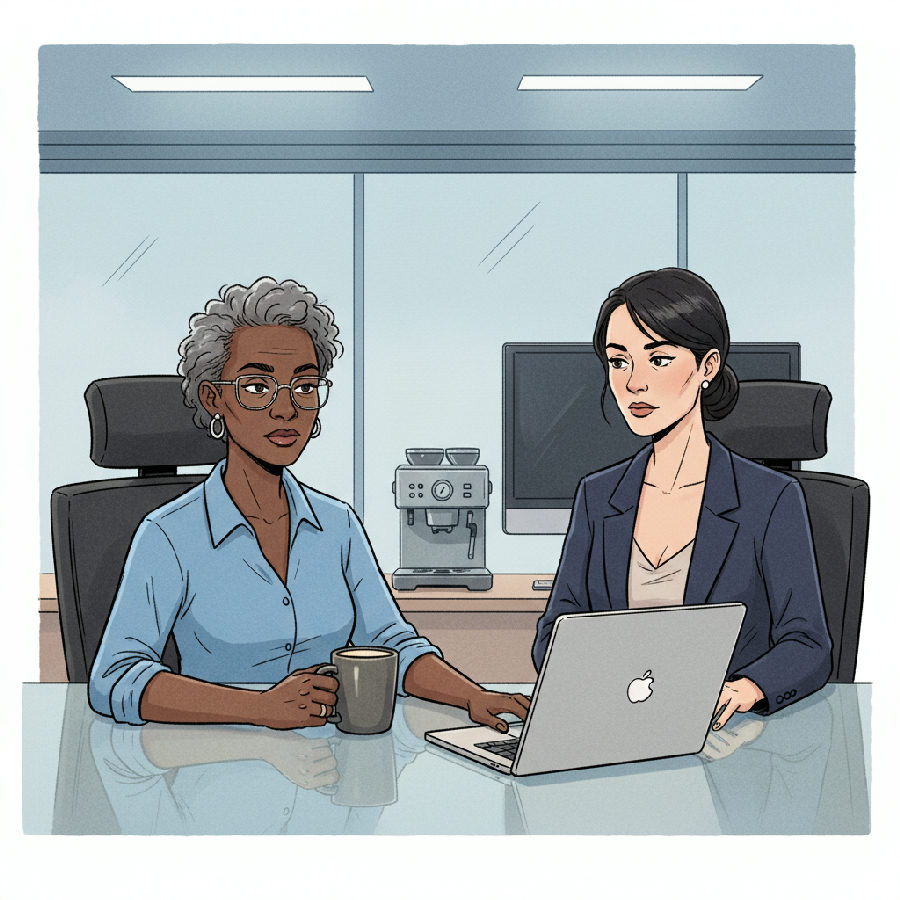
I remember the morning that Erin resigned, it was a Friday and the 13 th of the month. In hindsight I should have paid more attention and taken it as a sign. I remember the glow of my computer screen, the silence of the office punctuated by keyboard clatter from the surrounding workstations, and the bitter taste of my cold coffee because I had forgotten about it for most of the morning. I drank it anyway. Most of all I remember the way Erin tentatively closed the door behind her when she entered my office, as if she was hoping not to cause any more upset that she needed to.
That near inaudible click of the door closing was the first terrible thing.
She sat down across from me and told me she had accepted another offer. She was giving two weeks. She delivered the news gently. That’s what I remember most. She looked almost sorry for me. I smiled in a well-practiced managerial way, I congratulated her and I thanked her. I told her we’d make the transition smooth. I put on the face, you know the one. The face you make when your nervous system is about to make a run for it, but you need it to remain in the building.
Later in the washroom I locked myself in a stall and stared at the metal door watching my reflection in the brushed steel. I’m not ashamed to say that my heart was beating fast. Erin was not merely competent. She was the sort of competent that becomes invisible. The kind that makes a business feel sturdier than it is. Her title was Operations Manager. A clandestine title that tended to disappear in a meeting agenda like a ghost. The actual shape of her work was larger, stranger, and far more alive than that.
Erin, the Operations Manager, knew why the renewal report looked wrong on the first Monday of the month. She knew which client would accept a delay if you called before noon and which one would grow silent, then vindictive. She knew which broker never answered their email but replied to text messages almost instantly. She knew which pricing exception finance would approve, which one legal would stall, and which silent gatekeepers held each key. She knew the business in the way old houses know their own night sounds. Not as a diagram. As a living thing with moods and drafts and floorboards that creaked when you stepped in the wrong place.
I knew most of this too, but vaguely. Technically we had the documentation, of course. That was the second terrible thing. We had just enough documentation to reassure ourselves that there was nothing to fear. A Notion workspace full of stale confidence. A shared drive lined with files named Final, Final-Final, and Use This One. Half-recorded walkthroughs. Noble templates masquerading as final proofs. SOPs that described the business the way a brochure describes a city. No weather. No smell. No texture. No secret keys.
What we did not have was the private topography of the work. The hidden footpaths. The judgment. The little pauses when Erin’s spoke before she said, “No, don’t send that yet,” or “Move this one up,” or the certainty in her voice when she said, “That number is wrong, compare it to last Thursday’s export.” We did not have the map. We had postcards, and now that Erin was leaving, someone would have to interpret them.
Fiction — not based on actual events.