 My Employee is Leaving
Read the story
A short series about what actually left when one person did.

As the IT Admin departs, team members realize they can’t access critical systems.
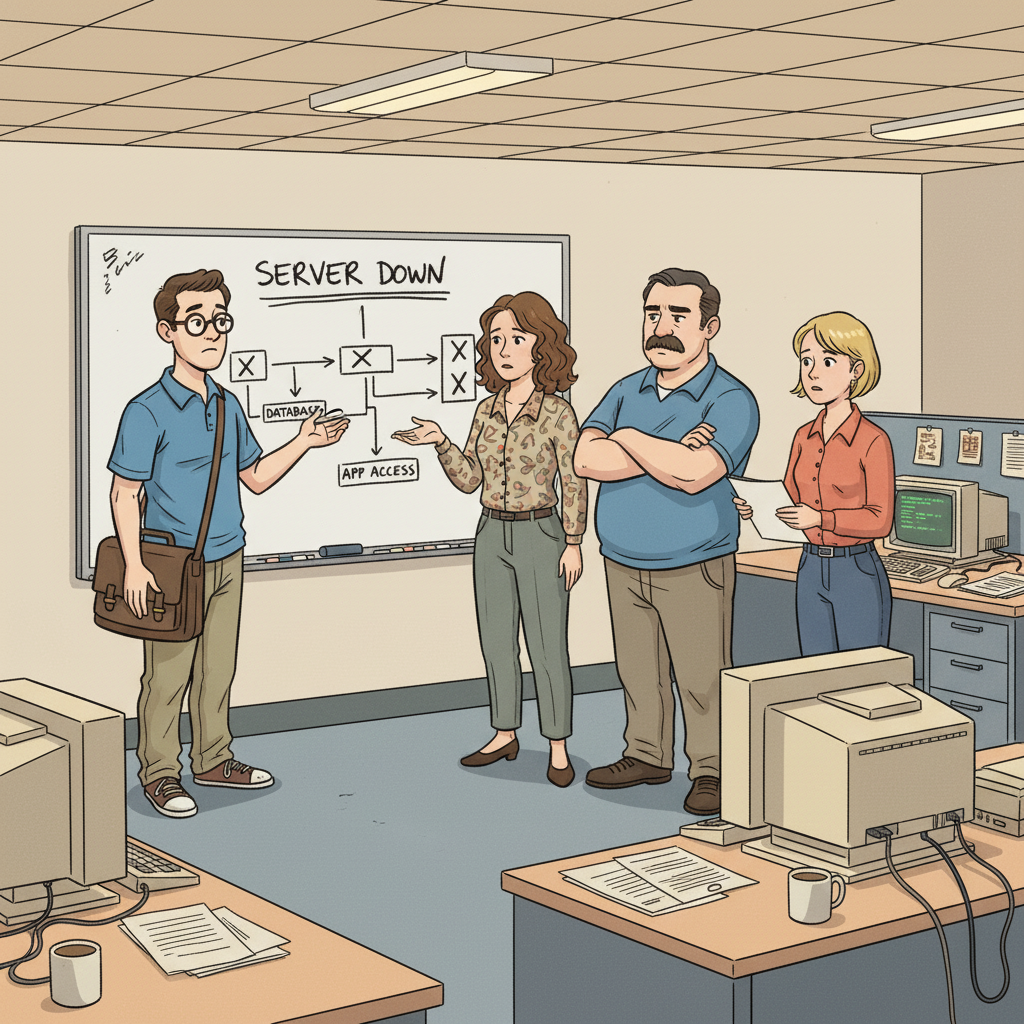
Network resources become unreachable, leading to a loss of productivity.

An overlooked scheduling of backups results in imminent data loss.

Access, backup schedules and patching notes, in the Knowledge Transfer Report — the unknowns are listed.
In brief: what happens when an IT / Systems Admin leaves?
Several operational disruptions arise, causing increased workload and communication failures.
What should a systems administrator hand over first?
Key systems and protocols such as backup processes and user account access must be prioritized.
Which access and infrastructure details are usually undocumented?
Important undocumented workarounds and shadow systems often remain unnoticed until issues arise.
What needs to happen in the two weeks after an administrator resigns?
Act promptly to conduct exit interviews and begin knowledge capture immediately.
The departure of an IT Admin can lead to critical failures across various systems and processes, resulting in operational chaos. Teams reliant on the Admin for their expertise can experience the following disruptions:
When the IT Admin departs, user access to shared drives and essential applications may be severely restricted. Without proper documentation, team members may face delays in retrieving necessary data.
Failure to execute timely backups can lead to data loss, especially if the backup systems are not well documented or regularly monitored.
With the IT Admin’s expertise gone, security measures may not be properly enforced, leaving systems open to attacks.
The cascading effects of these failures can be monumental, affecting not just the IT department but every unit that relies on technology to operate efficiently.
The Knowledge Transfer Report holds the backup schedule, the patching exceptions and the vendor contacts, with the unknowns listed.
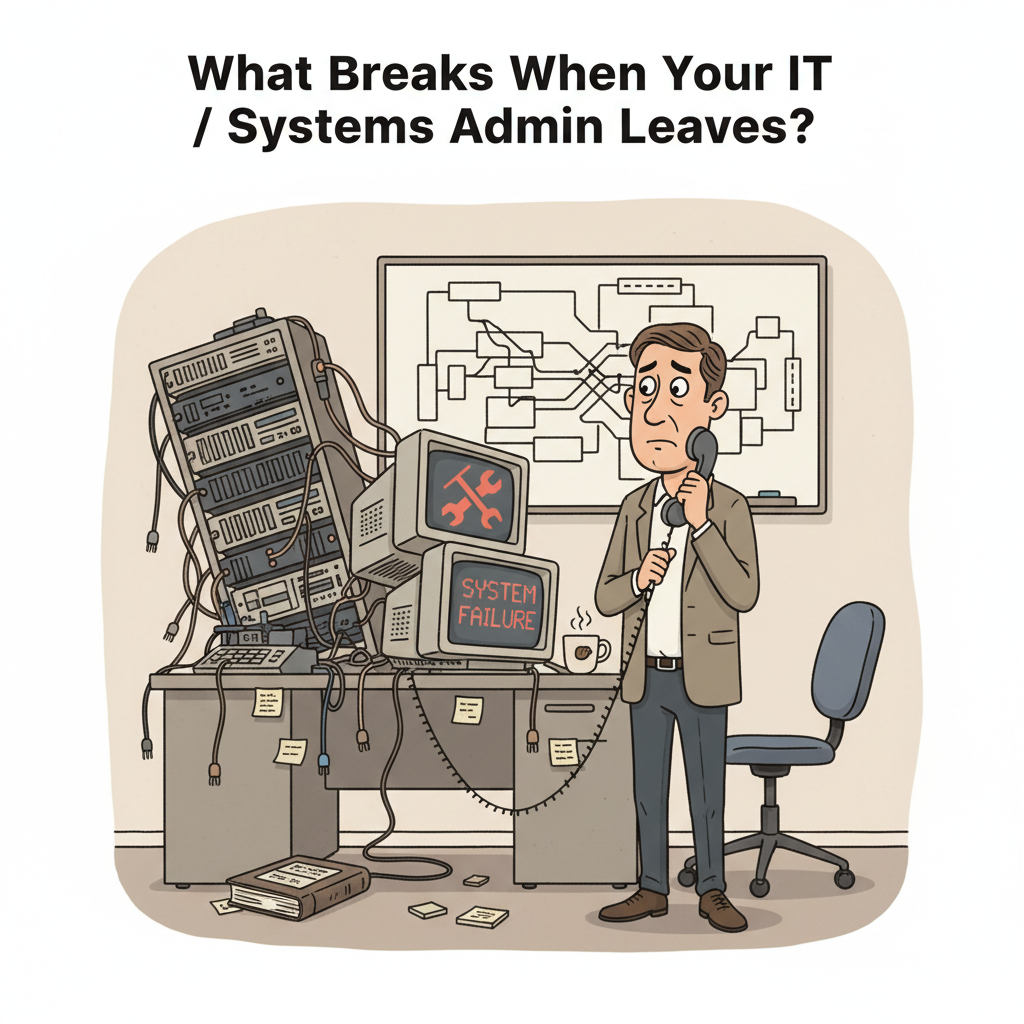
An IT / Systems Admin has a wealth of knowledge that directly impacts the functionality and security of the organization.
System Security Protocols
Knowledge of patching schedules and security configurations is vital for protecting sensitive information.
Server Maintenance Procedures
Regular updates and maintenance of Linux servers and Windows Server installations ensure system reliability.
Network Architecture and Topology
Understanding network configurations allows for swift and efficient troubleshooting of connectivity issues.
Each of these areas is crucial not just for day-to-day operations but also for business continuity. Many departments depend on the smooth functioning of these areas:
The Help Desk Support Team relies on accurate system statuses to assist end-users.
Business units need access to applications that manage daily workflows and communication.
Coordination with the Network Engineering Team addresses any hardware-related issues quickly.

To ensure that critical knowledge is retained during a transition, a structured AI-powered interview can identify vital information. Here are targeted questions that can reveal undocumented processes and dependencies:
Incorporating these questions into the knowledge transfer process can help transition responsibilities smoothly and maintain operational flow within the IT department.

The knowledge transfer report is an essential tool that compiles all relevant data gathered during the transition. Key deliverables include:
Creating a comprehensive report maximizes operational continuity and fosters smoother transitions during personnel changes.

A guiding checklist to streamline the documentation process during the transition.
Schedule interviews to capture critical undocumented knowledge and clarify systems access.
Identify regular tasks and patch schedules for both Linux and Windows environments.
Ensure that all vendor relationships and escalation paths are captured.
Ensure backups are occurring regularly and document any recovery processes.
Detail each component of the network, including configurations for Cisco Network Devices.
Align on expectations and communicate any access or resource changes.
A short series about what actually left when one person did.
A real Knowledge Transfer Report, start to finish.
One $1,000 credit per offboarding. No subscription. Your first offboarding runs free for 7 days — you buy the credit when you unlock its Knowledge Transfer Report.
The adjacent role, and where the boundary sits.
The manager learns the IT / Systems Admin is leaving and initiates the knowledge transfer process.
An AI-guided interview session is scheduled with the departing IT / Systems Admin to systematically capture institutional knowledge.
The AI interview extracts undocumented workflows, vendor relationships, decision rationale, and operational edge cases.
A structured knowledge transfer report is produced, covering all critical domains, handover checklists, and risk areas.
The team reviews the report, identifies remaining gaps, and completes the handover before the departure date.
An IT Admin’s departure can cause various issues, including loss of access to important systems, increased security risks, and a backlog of unresolved service requests.
Fit comes from the role’s operational knowledge, not the access it holds. It’s designed for operational knowledge — vendor escalation paths, recurring failure patterns, and the reasoning behind current configuration; passwords, credentials, and secrets stay out of scope.
Conducting structured interviews and documenting processes through an AI-driven platform ensures that critical tasks and workflows are retained before departure.
It’s multi-session by design, not a single sitting. An offboarding can cover up to ten structured topics with a total interview budget of around 300 minutes — in voice or text, paused and resumed around the person’s actual work. Time is budgeted, not promised: if topics don’t complete, the report says so rather than filling the gap.
Get a comprehensive handover checklist and practical insights for capturing vital retail knowledge before your ops lead departs.
In financial services, ops and back-office memory walks out with the person. A guided interview captures the reasoning, confirmed fact by fact.
Explore effective knowledge transfer strategies to capture critical information when an employee gives two weeks notice, ensuring smooth transitions.
Capture crucial knowledge seamlessly when a SaaS team member leaves. Get operational playbooks, decision rationale documentation, and more.
Explore industry-specific strategies for effective knowledge transfer before employee departures. Capture critical insights easily!
Capture essential donor management knowledge with this checklist, ensuring your nonprofit stays funded and organized after staff transitions.