 My Employee is Leaving
Read the story
A short series about what actually left when one person did.

Sales forecasts become unreliable without the RevOps lead’s input.

Communication breakdowns leave teams disjointed and frustrated.

Inefficient lead routing leads to lost opportunities.

Forecast logic and lead-routing rules, in the Knowledge Transfer Report — the reporting gaps named.
In brief: what happens when a RevOps / Sales Ops Lead leaves?
Key operational vulnerabilities arise, leaving teams exposed to inefficiencies.
Which CRM logic should be documented before the last day?
The documentation of critical lead scoring models and CRM customization should be prioritized.
What reporting and scoring context tends to disappear?
Crucial undocumented workarounds are often overlooked, leading to disruptions.
What should revenue operations cover in the first two weeks?
A structured knowledge transfer session is essential to clarify existing workflows.
When a RevOps / Sales Ops Lead exits, the organization’s pipeline integrity faces several threats. Vital processes that ensure operational flow begin to falter:
Without the RevOps lead’s comprehensive forecasting, the accuracy of sales predictions declines notably. Teams relying on the CRM may find historical data outdated, leading to:
A lack of structured communication between sales and marketing teams can unravel the existing relationship and lead to missed opportunities. Teams might misalign campaign strategies due to:
With the exit of a knowledgeable RevOps lead, reporting becomes delayed, impacting decision-making. The ability to generate accurate KPI assessments is compromised, risking:
The sales team’s ability to utilize effective strategies diminishes. Without a clear understanding of sales enablement resources, representatives can struggle, leading to:
Understanding these breakdowns is crucial for mitigating risks associated with a key RevOps lead’s departure.
The Knowledge Transfer Report writes down the forecast logic, the routing rules and the vendor contacts, with the reporting gaps named.

The departure of a RevOps / Sales Ops Lead triggers concern surrounding specific knowledge domains that underpin organizational success:
A deep understanding of the sales process is vital. This encompasses:
Their unique insight into data analytics enables teams to:
The interplay between sales and marketing is essential:
These knowledge areas are shared among teams. The finance team relies on accurate sales data, while customer success teams need feedback loops to retain clients effectively.

An AI-assisted interview can uncover essential insights when a RevOps / Sales Ops Lead departs. Key questions involve:
These inquiries, when thoroughly explored, provide a pathway to capturing knowledge effectively.

A comprehensive knowledge transfer report is instrumental for ensuring a smooth transition from a departing RevOps / Sales Ops Lead. This document includes:
Detailed guides outlining processes that the sales team or marketing team can follow. These playbooks encompass:
Capturing the reasoning behind critical tools and vendor selections:
Structured checklists facilitate a seamless transition and include:
Establishing clear deliverables helps mitigate risks related to incomplete knowledge capture.

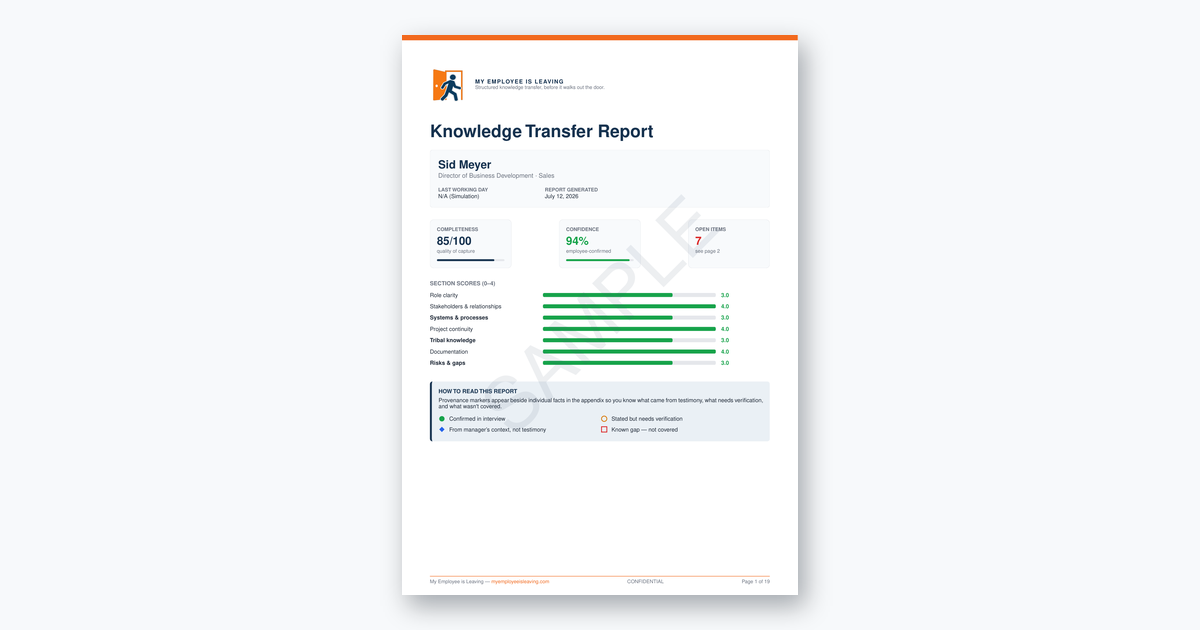
We generated a full Knowledge Transfer Report for a fictional Director of Business Development — the frameworks, partner scorecards, and decision history that lived half in dashboards and half in his head. Captured mid-quarter, under realistic time pressure.
Address critical operational areas during the RevOps / Sales Ops Lead’s departure.
Clarify the criteria used and how it integrates with the CRM for lead prioritization.
Compile information on campaigns run through the marketing automation platform, including definitions of success metrics.
Generate a directory of vendor contacts, including their roles and responsibilities.
Document how sales forecasts were created and outline any historical challenges encountered.
Organize sessions with outgoing RevOps lead to clarify remaining uncertainties and knowledge gaps.
A short series about what actually left when one person did.
A real Knowledge Transfer Report, start to finish.
One $1,000 credit per offboarding. No subscription. Your first offboarding runs free for 7 days — you buy the credit when you unlock its Knowledge Transfer Report.
The overlapping role, and where the handoffs break.
The manager learns the RevOps / Sales Ops Lead is leaving and initiates the knowledge transfer process.
An AI-guided interview session is scheduled with the departing RevOps / Sales Ops Lead to systematically capture institutional knowledge.
The AI interview extracts undocumented workflows, vendor relationships, decision rationale, and operational edge cases.
A structured knowledge transfer report is produced, covering all critical domains, handover checklists, and risk areas.
The team reviews the report, identifies remaining gaps, and completes the handover before the departure date.
The departure leads to potential inaccuracies in sales forecasts and disruptions in lead management, affecting overall sales performance.
Fit comes from the role’s operational knowledge, not the systems it administers. It’s designed for operational knowledge — routing logic, forecasting reasoning, and the vendor relationships behind the stack; customer records, credentials, and controlled financial data stay out of scope.
By conducting structured interviews and documenting processes using AI tools, crucial knowledge and insights can be captured effectively.
It’s multi-session by design, not a single sitting. An offboarding can cover up to ten structured topics with a total interview budget of around 300 minutes — in voice or text, paused and resumed around the person’s actual work. Time is budgeted, not promised: if topics don’t complete, the report says so rather than filling the gap.
Capture essential donor management knowledge with this checklist, ensuring your nonprofit stays funded and organized after staff transitions.
Discover strategies for knowledge transfer after a sudden resignation, ensuring critical operational continuity and relationship preservation.
Capture campaign insights and client context before your marketing agency employee departs with our detailed knowledge transfer checklist.