 My Employee is Leaving
Read the story
A short series about what actually left when one person did.

Sudden departure leaves a knowledge void, pushing the team to scramble for answers.

Processing delays in loan approvals disrupt client relationships and operations.
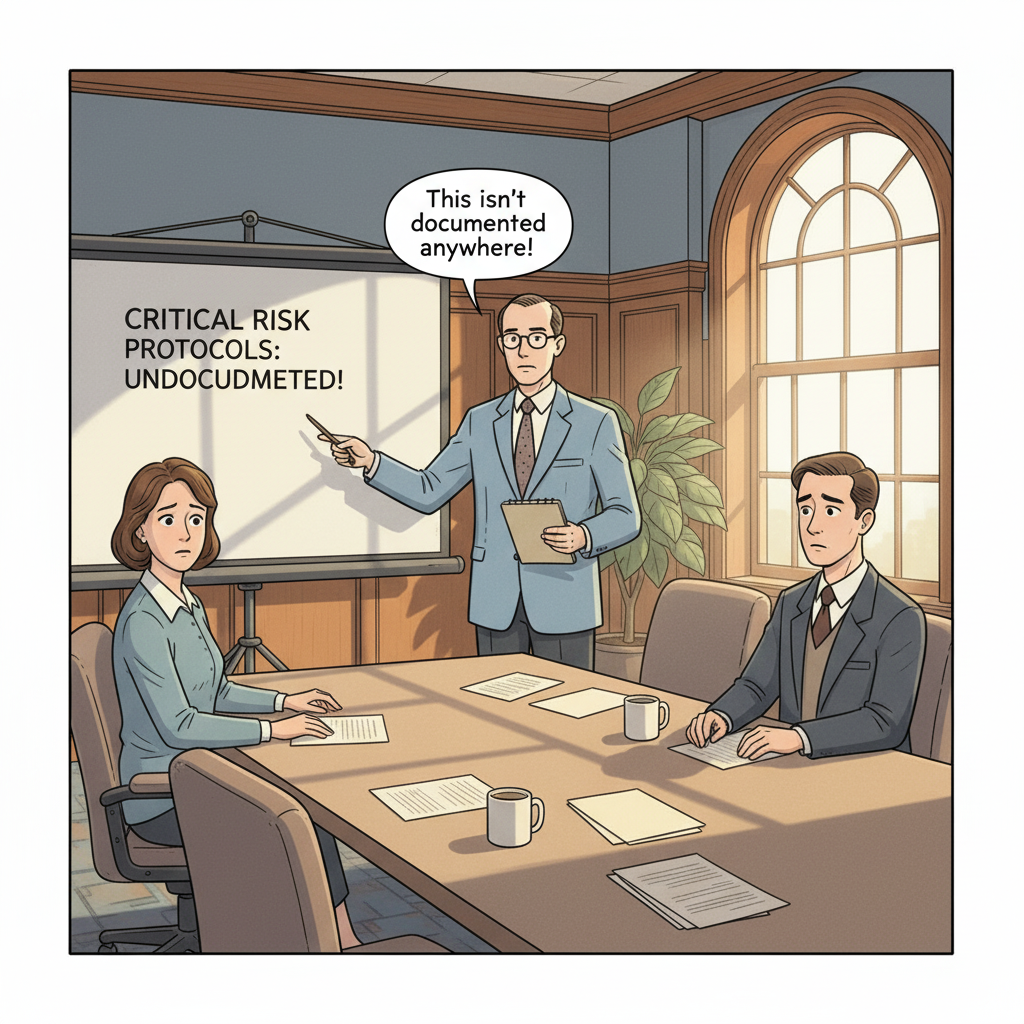
The room remembers the process but not the reasoning that shaped it.

The loan-approval steps and their reasoning, in a Knowledge Transfer Report — open items marked.
Most of what keeps a financial operation moving isn’t in the regulated systems — it’s the person who knows which exception is routine, which vendor actually answers, and why the month-end process has that extra step. A guided interview captures that reasoning, confirmed fact by fact, before their notice period ends.
The resignation is polite and the timing is terrible. Month-end is in nine days.
The systems are unaffected. The controls are unaffected. What leaves is the person who knew which exception is routine and which one is worth stopping for, which vendor answers on the first call, and why there is an extra reconciliation step that has been there for three years because of something that went wrong once.
Everything technically works and everything takes longer. Capturing the reasoning while they are still here reduces that risk; it does not remove it.

Below the regulated core there is an operational spine, and it is mostly people and habits.
None of it is secret. It is never written down, because the person doing it has no reason to write it down for themselves.

Ask a back-office lead to describe month-end and you get the documented version. Ask where they step in without being asked and you get the real one.
The useful knowledge is usually phrased as an aside: “I always check that one before sign-off.” That aside is a control nobody has recorded. The interview follows those asides, because they are where the process memory lives. Anything the person is unsure about stays marked as uncertain instead of being written up as settled fact.

It is a guided offboarding interview, voice or text, whichever the employee prefers. It runs across short sessions rather than one long booking, so it can sit around the working day.
Extracted facts go back to the employee to confirm, edit, or reject before anything reaches the report. Two consequences: the account is theirs, and their uncertainty survives the process instead of being flattened out of it.

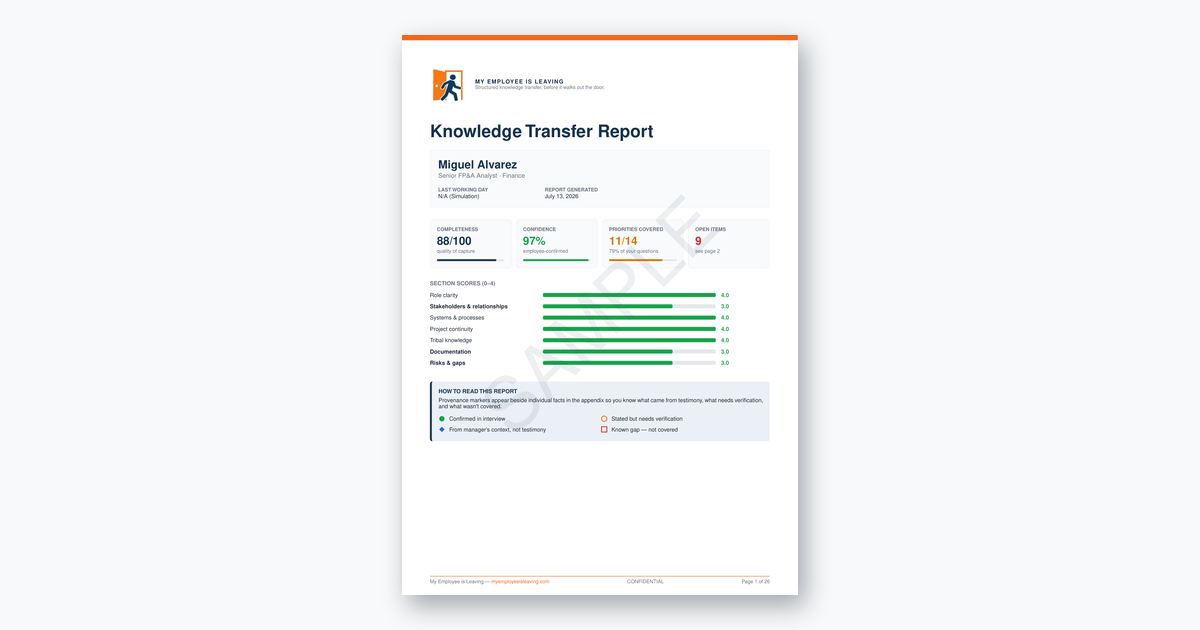
The report has three parts. The lines below illustrate the shape — they are not a real customer’s report.
“The intercompany balance is checked against the treasury file before sign-off; this step is not in the process document.”
“She was unsure whether the manual upload for the smaller entity is still needed after last year’s system change. Confirm with the systems team.”
“Vendor renewals were not reached; the time budget went on month-end and exceptions.”
The gaps are the point. They give a manager somewhere specific to look rather than a false sense that everything has been captured.
Five questions the guided interview puts to an operations or back-office lead, and what each one is for.
The unasked-for steps are the ones missing from every process document.
This is judgment, and without it the next person escalates the wrong things.
Manual bridges break quietly and are expensive to rediscover.
Escalation routing lives in relationships, not org charts.
Work in progress is the first thing to fall over after a last day.
A short series about what actually left when one person did.
A full Knowledge Transfer Report for a Senior FP&A Analyst, start to finish.
One $1,000 credit per offboarding. No subscription. Your first offboarding runs free for 7 days — you buy the credit when you unlock its Knowledge Transfer Report.
The adjacent operations role, and where its handoffs break.
The manager learns the key employee is leaving and initiates the knowledge transfer process.
The interview is booked inside the notice period, timed around month-end so the person isn’t answering questions mid-close.
The session draws out the reconciliation steps added over the years, which exceptions this person waves through, and the manual bridges between systems that only they maintain.
A structured Knowledge Transfer Report is produced from the confirmed facts, with open questions and a section on what was not covered.
The incoming analyst and the manager walk the report together, close the open questions, and run one month-end cycle while the departing person is still reachable.
Process memory. The systems stay and the controls stay, but the reasoning behind the extra checks, the exception calls, and the vendor relationships leaves with the person. A guided interview captures it in their words, confirmed fact by fact.
Fit is decided by the role’s knowledge, not the industry around it — operations, vendor, and internal-process roles inside a bank can be a strong fit, while controlled financial data and client records stay out of scope. The interview asks how operational work is done and why: process ownership, vendor contacts, escalation routing, the reasoning behind exceptions.
Multi-session by design: up to 10 structured topics, voice or text, pause and resume anytime, with a total time budget of up to roughly 300 minutes. Time is budgeted, not promised. That makes it workable in the gaps around a month-end close rather than in place of one.
Judgment is the part worth capturing. The questions are open-ended, so the answers come out as reasoning rather than steps, and follow-ups press on the interesting bits. Where the person is uncertain, the report records it as an open question instead of resolving it for them.
Learn essential knowledge transfer steps for Security Engineers to avoid operational disruptions during their departure.
Explore a detailed guide on handling knowledge transfer when your founder hands off operations, including crucial documentation strategies.
When your IT or systems admin leaves, the setup reasoning and vendor contacts go too. A guided interview captures that context, never the secrets.
Secure critical knowledge from your departing Operations Manager using our comprehensive checklist and insights.