 My Employee is Leaving
Read the story
A short series about what actually left when one person did.

Panic sets in as the founder notices incomplete project plans.

Confusion unfolds as teams struggle with unclear roles and responsibilities.

Operational inefficiencies emerge as knowledge gaps impact client relationships.

The operations lead starts from the founder’s Knowledge Transfer Report — reasoning included, open questions named.
Knowledge loss can lead to strategic misalignment and operational chaos, impacting multiple teams.
Key relationships and decision-making processes should be prioritized in documentation.
Undocumented workarounds and project insights are often overlooked.
Initiate structured knowledge transfer sessions to capture essential insights.
When a founder hands off operations, several critical aspects are at risk of failure:
When the founder’s insights are lost, teams spend critical time deciphering what should have been explicitly documented.
The Knowledge Transfer Report writes down the reasoning behind the half-finished ideas and the standing agreements, with the open questions named.

A founder’s knowledge spans multiple critical areas:
The founder understands the competitive landscape, guiding strategic decision-making.
Capturing this knowledge ensures continuity across the organization.

Structured interviews can uncover essential, undocumented processes:
These inquiries help convert ambiguous knowledge into actionable insights, preserving continuity post-departure.
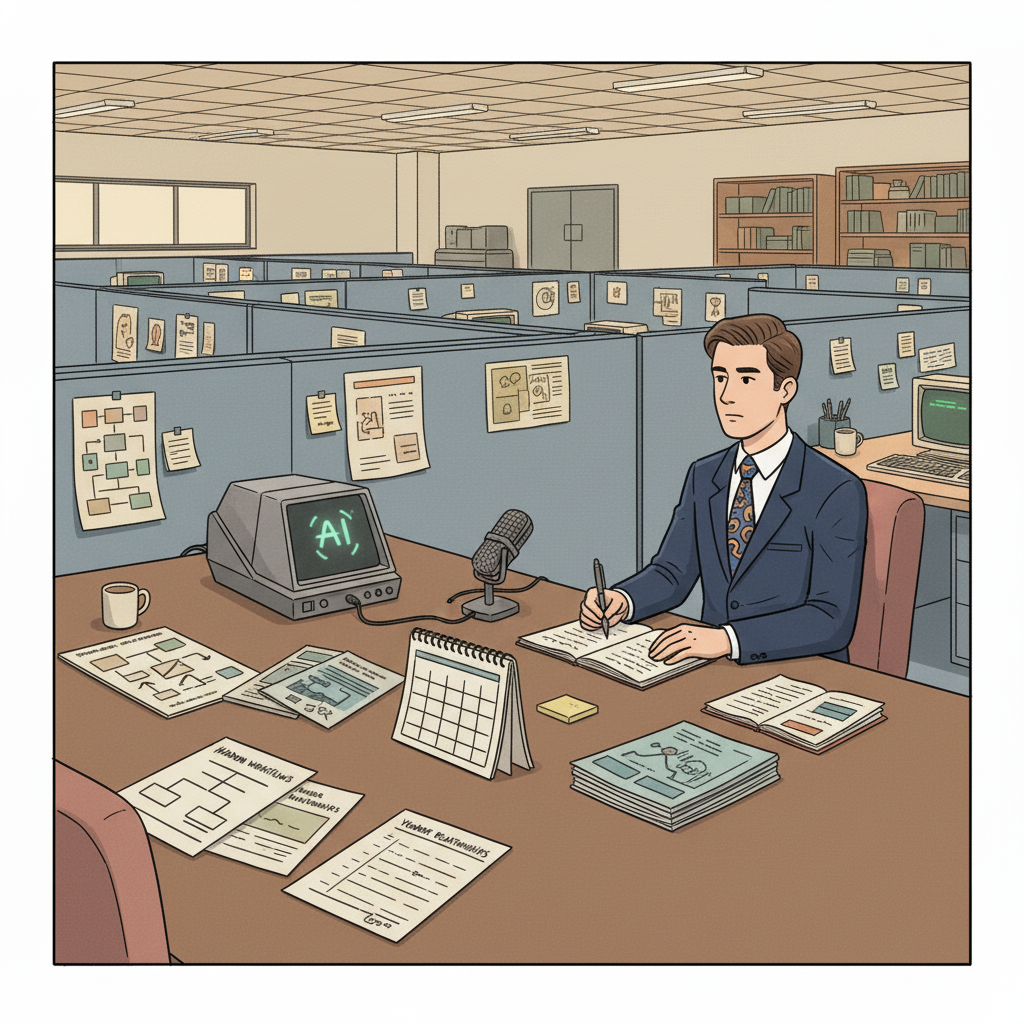
The final knowledge transfer report is invaluable. It encapsulates:
This structured approach empowers the succeeding leadership to continue the vision without disruption.

Capture critical operational insights to reduce knowledge loss during transitions.
Outline current goals and timelines, ensuring clarity for team execution.
Gather contact details and service agreements essential for ongoing operations.
Summarize budgeting processes, allocations, and historical context.
Detail the usage of your project tracker, ensuring team members can easily navigate.
Document leadership philosophy and team engagement strategies for continuity.
A short series about what actually left when one person did.
A real Knowledge Transfer Report, start to finish.
One $1,000 credit per offboarding. No subscription. Your first offboarding runs free for 7 days — you buy the credit when you unlock its Knowledge Transfer Report.
What a founder actually carries.
The manager learns the Founder / CEO is leaving and initiates the knowledge transfer process.
An AI-guided interview is scheduled as part of the handoff plan, timed so the founder is still around to answer the follow-up questions it raises.
The interview maps the operating routine being handed over — supplier and client contacts, the order in which things actually get approved, recurring month-end tasks, and the exceptions the founder has always absorbed personally.
A structured knowledge transfer report is produced, covering all critical domains, handover checklists, and risk areas.
The incoming owner of each area walks the report through with the founder, confirms who now holds each responsibility, and signs it off before the handover date.
Their departure often leads to the loss of crucial knowledge regarding operational protocols, client relationships, and team dynamics, causing significant disruption.
Fit is decided by what the role knows, not how senior it is. It’s designed for operational knowledge — supplier and partner history, informal decision rules, and escalation order; controlled financial data and privileged legal material stay out of scope.
Employ structured interviews and documentation processes that focus on operational insights, decision-making approaches, and vendor relationships to minimize knowledge gaps.
It’s multi-session by design, not a single sitting. An offboarding can cover up to ten structured topics with a total interview budget of around 300 minutes — in voice or text, paused and resumed around the person’s actual work. Time is budgeted, not promised: if topics don’t complete, the report says so rather than filling the gap.
In financial services, ops and back-office memory walks out with the person. A guided interview captures the reasoning, confirmed fact by fact.
Everything lives in your head — until it doesn't. Structured knowledge transfer for founders handing off operations.
Learn the essential checklist and actionable steps for effective Knowledge Transfer for Retiring Employees before they leave.
Access a checklist and interview questions essential for effective knowledge transfer in professional services, ensuring operational continuity.
Ensure a smooth transition in manufacturing with our structured knowledge transfer sessions, minimizing operational disruptions and knowledge loss.
Secure critical knowledge from your departing Operations Manager using our comprehensive checklist and insights.