 My Employee is Leaving
Read the story
The relationships and history that never make it into a handover document.

A promotion is a real transition — it just does not look like one.

The old work is split three ways, and the reasoning that held it together is not.

Still in the building, and already out of reach.

The old role’s rules are in a Knowledge Transfer Report now; the exceptions have an owner.
The person stays but their old work loses its owner, and everyone assumes the context is still available because the person is.
The person leaving the role, not the successor — the successor uses the report as their starting point.
Because attention moves on the first day of the new role, and the reasoning behind the old work goes with it.
Treat the promotion date as a handover deadline, not just a start date.
The person stays, but their old work loses its owner the day the new role starts.
Week one, the old work is still answered from the new desk. By week four the new role has filled the calendar and the questions go unanswered. Around month three an exception arrives at one of the three people who inherited a piece, and none of them knows the rule that used to handle it. The Knowledge Transfer Report puts the old role’s rules in writing, with an owner named for each exception.

Most of it has never been written down, because the person has always been at the next desk.
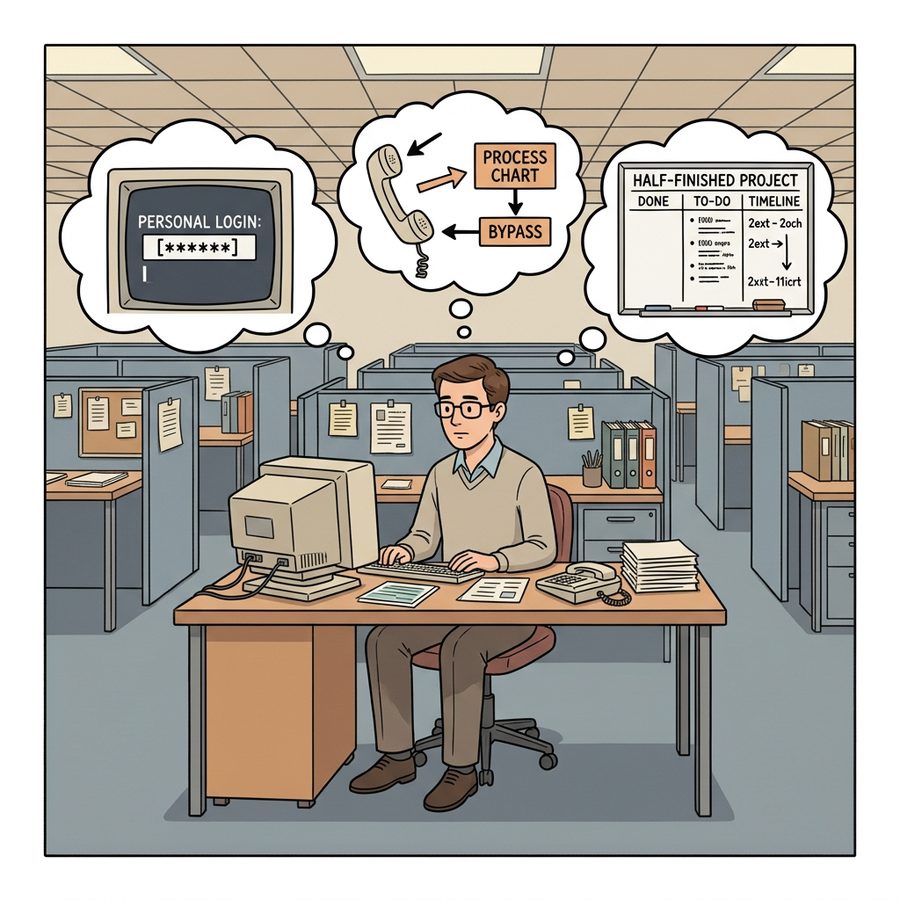
An internal promotion is a real transition, and the transition date is already confirmed.

The deliverable is a structured Knowledge Transfer Report the receiving manager can actually review.

Ground to cover before the new role takes over their calendar.
The task you do because nobody else knows it exists.
Name the exception and how you decided.
Accounts, dashboards, and shared logins that should not follow you into the new role.
Internal and external — those calls will keep coming.
State of play plus the reasoning behind the next step.
The contacts who will keep calling you unless someone else is put in front of them.
The relationships and history that never make it into a handover document.
Judge the depth of the Knowledge Transfer Report before committing to anything.
One $1,000 credit per offboarding. No subscription. Your first offboarding runs free for 7 days — you buy the credit when you unlock its Knowledge Transfer Report.
The same problem when the person is away rather than moving on.
The start date for the new role sets the deadline for the old one’s handover.
Booked before the new role takes over the calendar.
Undocumented ownership, judgment calls a checklist would get wrong, personal access, and work in flight.
The person confirms or corrects each extracted fact while the detail is still fresh.
A completeness-scored report with open questions listed, handed to whoever inherits each piece.
Because their attention moves on the day the new role starts. The interview captures the reasoning while the old work is still fresh.
The person leaving the role. Their successor uses the report as the starting point for review.
Yes — one $1,000 credit covers one transition, including the multi-session interview and the final report.
It is scored for completeness and lists the questions still open. It reduces surprises; it does not promise there are none.
Fit is decided by what the vacated role knows, not how senior the promotion is. It’s designed for operational knowledge — undocumented ownership, informal decision rules, and the escalation order people actually use; regulated records and controlled data stay out of scope.
Discover the importance of capturing critical knowledge when employees leave. Don't let operational continuity suffer during transitions.
Maintenance managers carry an unwritten service history. A guided interview captures the equipment quirks and vendor reality before they go.
Explore the Engineering Pivot Map to navigate critical knowledge transfer during employee departures. Prevent disruptions and operational gaps.
Access a structured checklist and actionable insights for effective knowledge transfer in logistics when a key member departs.
Capture essential knowledge when a Food Safety Manager departs. Get practical checklists, interview questions, and risk assessments.
Capture vital knowledge from your Production Supervisor with structured interviews and Knowledge Transfer Reports for seamless offboarding.